Medication for Opioid Use Disorder (MOUD), Explained
Medication for opioid use disorder (MOUD), sometimes called medication-assisted treatment (MAT), is one of the most effective tools in addiction medicine. Yet it remains widely misunderstood. This guide explains how the FDA-approved medications work and addresses the most common myths.
Why medication helps
Opioid use disorder changes how the brain's reward and stress systems function. MOUD works on those same systems to reduce cravings and withdrawal, which makes it possible to stabilize, stay in treatment, and rebuild daily life. Research consistently shows that medication for opioid use disorder reduces overdose deaths and improves treatment retention compared with no medication.
The three FDA-approved medications
Methadone
Methadone is a long-acting full opioid agonist that, taken at a steady dose, prevents withdrawal and reduces cravings without producing the highs and lows of misuse. In the United States it is dispensed through licensed opioid treatment programs (OTPs), often daily at first, which also provides structure and regular contact with care.
Buprenorphine
Buprenorphine is a partial opioid agonist, frequently combined with naloxone (a formulation many people know by brand names). Because it is a partial agonist, it has a 'ceiling effect' that lowers overdose risk, and it can be prescribed in office-based settings, which has expanded access. It similarly reduces cravings and withdrawal.
Naltrexone
Naltrexone is an opioid antagonist — it blocks opioid effects rather than activating receptors. The extended-release injectable form is given monthly. Because it is not an opioid, it has no misuse potential, but a person must be fully withdrawn from opioids before starting it, which makes timing important.
How long do people stay on MOUD?
There is no universal timeline. For many people, opioid use disorder is best understood as a chronic condition, and staying on medication for an extended period — sometimes years — is both safe and protective, much like ongoing medication for other chronic conditions. Decisions about continuing or tapering should be made with a clinician based on the individual's stability and goals, not on outside pressure.
Common myths
- Myth: 'MOUD just replaces one addiction with another.' Reality: at a stable, prescribed dose, these medications normalize brain function without producing intoxication; taking a medication as prescribed for a medical condition is not the same as addiction.
- Myth: 'You have to hit rock bottom before medication can help.' Reality: earlier treatment generally leads to better outcomes; there is no benefit to waiting.
- Myth: 'Medication is a sign of weak willpower.' Reality: addiction is a medical condition, and using effective medicine is a sign of good care, not weakness.
- Myth: 'Detox alone is enough.' Reality: detox without ongoing treatment and, when appropriate, medication is associated with high relapse and overdose risk.
Medication is part of a plan
MOUD is most effective combined with counseling, support, and treatment for any co-occurring conditions. The right combination is individual. If a program does not offer medication for opioid use disorder, it is reasonable to ask why, and to consider whether a program that does would be a better fit.
Beyond the script: 5 insights from a decade of opioid treatment research
The opioid crisis remains a staggering, evolving public health challenge. According to data from the Observational Health Data Sciences and Informatics (OHDSI), roughly 2.7 million Americans lived with an opioid use disorder (OUD) as of 2020 — and about 75% of the nation's 107,622 drug overdose deaths in 2021 involved opioids. While FDA-approved medications effectively stabilize the brain, the central challenge is not the initial prescription but the long-term commitment. In clinical terms, retention — staying engaged in care over time — is the ultimate barometer of success, and recent 10-year studies and major meta-analyses are revealing why some patients thrive while others fall through the cracks.
1. Methadone still holds the retention crown
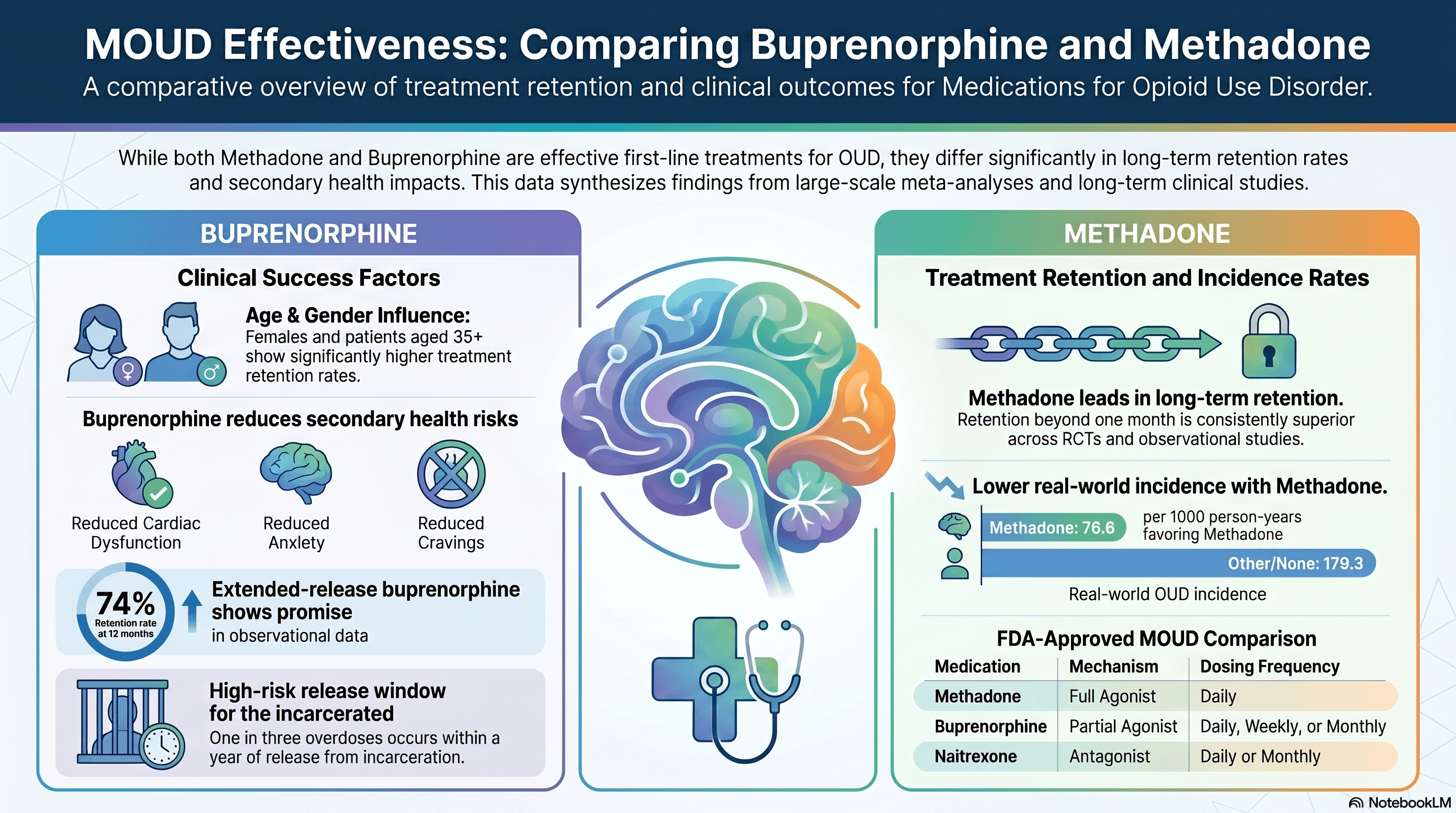
A 2023 meta-analysis in The Lancet Psychiatry analyzed data from over one million participants comparing methadone (a full agonist that fully activates opioid receptors) and buprenorphine (a partial agonist). At nearly every timepoint beyond one month, methadone showed superior retention in both clinical trials and real-world data — often attributed to its higher-structure, daily-clinic model versus the more flexible office-based model of buprenorphine. As the researchers put it: 'Evidence suggests better retention in treatment with methadone than with buprenorphine, although retention for both medications, particularly over the long term, is suboptimal.' Client-centered factors — such as earning unsupervised dosing privileges and the total cost to the individual — also shape who stays in care.
2. Age and gender shape the path to recovery
A 10-year retrospective study of a West Virginia clinic (Zheng et al.) measured success through 90-day retention. It found a real demographic 'success gap': female patients showed higher resilience (a 60.1% retention rate for multiple admissions versus 53.0% for male patients), and patients aged 35 and older achieved the highest retention, while those 24 and younger struggled most to remain in care. The takeaway: one size does not fit all, and younger patients likely need more intensive, age-specific support to avoid early dropout.
3. The induction paradox: safety vs. staying power
The first weeks of treatment (induction) involve a trade-off. Sublingual buprenorphine is prized for its safety — a 'ceiling effect' on respiratory depression makes a fatal overdose on the medication alone nearly impossible. Yet the drug that is safest to start is often the hardest to stay on: methadone offers better long-term retention but carries a first-four-weeks mortality risk about 2.81 times higher than buprenorphine before tolerance is professionally stabilized. Clinicians must balance immediate survival against long-term engagement.
4. The next frontier: long-acting 'depot' injections
A major hurdle is the daily burden of taking a pill or film. Extended-release ('depot') buprenorphine injections last weeks to months, removing that daily decision. The retention signal is promising — pooled data for sublingual versions shows retention around 43% at 12 months, while some extended-release data shows retention as high as 74% at the same mark. That 74% figure deserves real caution, however: it was synthesized from only two studies, so the uncertainty is high and far larger trials are needed before calling it a 'silver bullet.'
5. The jail-to-community gap is lethal
One of the most dangerous moments for someone with OUD is leaving incarceration: per the Minnesota MOUD in Jails Workgroup, about 1 in 3 overdoses in Minnesota occurs within a year of a person being incarcerated — often because people return to the community with lowered tolerance and no immediate access to medication. Providing MOUD during incarceration reduces post-release deaths and re-incarceration, yet a 2024 survey of 1,028 jails found fewer than half offered any MOUD, and only 12.8% made it available to everyone with the disorder. Closing this gap — with treatment during incarceration and a warm hand-off to community providers — is both a medical necessity and a public-safety issue.
Reimagining the gold standard
The past decade teaches that having effective tools is only half the battle. We have medications that stabilize the brain; the 'human factor' — staying in the system — is where recovery is won or lost. Retention is not just a patient responsibility but a measure of how well the system accommodates a person's life. The most effective medication is ultimately the one a person actually stays on, which means our definition of success must account for dosing flexibility, cost, and the support around the person — not just the drug itself.
Slides
Frequently asked questions
Is medication-assisted treatment effective?
Yes. Medications for opioid use disorder are FDA-approved and supported by strong evidence showing reduced overdose risk and improved retention in treatment, especially when combined with counseling and support.
Does MOUD just trade one addiction for another?
No. At a stable prescribed dose, these medications reduce cravings and withdrawal without causing intoxication. Taking a prescribed medication for a medical condition is different from active addiction.
How do I find a program that offers MOUD?
Many facilities list whether they provide medication for opioid use disorder. You can filter for MOUD availability and contact programs directly to confirm which medications they offer.