How to Recognize an Opioid Overdose and Use Naloxone (Narcan)
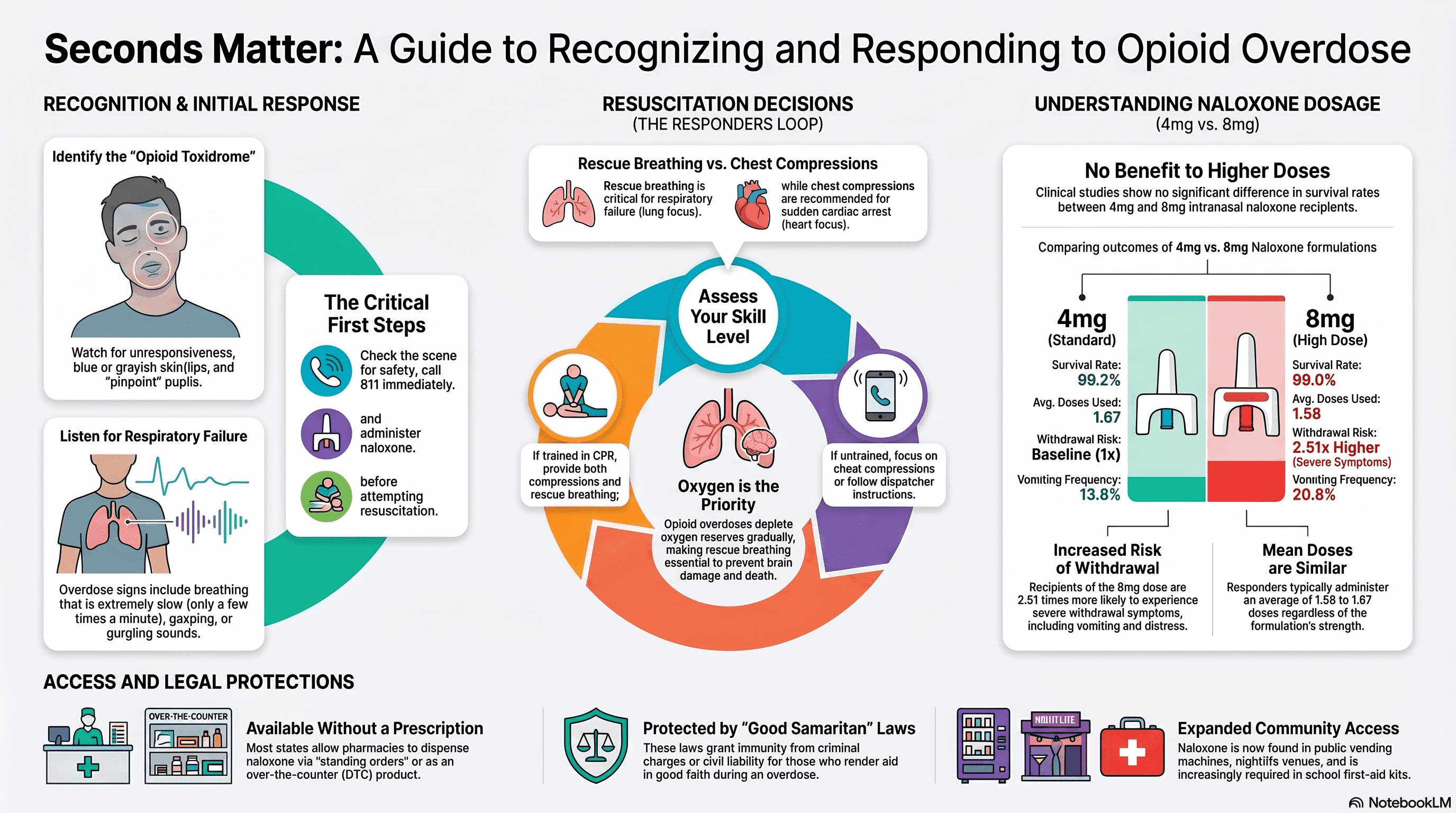
An opioid overdose is a medical emergency, but it is often reversible if someone acts fast. Naloxone (commonly known by the brand name Narcan) can restore breathing within minutes, and anyone can learn to use it. This guide explains how to recognize an overdose and exactly what to do. If you are facing an emergency right now, call 911 immediately.
This is emergency information
If you think someone is overdosing, do not wait. Call 911, give naloxone if you have it, and follow the steps below. It is always better to act — naloxone is safe to give even if you are not certain opioids are involved, and it will not harm someone who has not taken opioids.
Signs of an opioid overdose
An overdose suppresses breathing. Warning signs include:
- Slow, shallow, or stopped breathing.
- Unresponsive — cannot be woken by shouting their name or a firm rub on the breastbone.
- Pinpoint (very small) pupils.
- Blue, gray, or ashen lips, fingertips, or skin.
- Choking, gurgling, or a snore-like gasping sound (sometimes called the 'death rattle').
- Limp body, and slow, erratic, or absent pulse.
What to do — step by step
- Call 911 immediately. Say the person is not breathing or is unresponsive and give your location.
- Give naloxone if available. Use a nasal spray or injection as directed (see below).
- Support their breathing. If they are not breathing, give rescue breaths if you are able — tilt the head back, pinch the nose, and give one breath every few seconds.
- Wait and watch. Naloxone takes a few minutes to work. If there is no response after 2–3 minutes, give a second dose.
- Stay with the person. Naloxone wears off in roughly 30–90 minutes, and the overdose can return — this is why emergency help is essential even after they wake up.
- Put them in the recovery position. If they are breathing on their own and you must step away, roll them onto their side to prevent choking.
How to give naloxone
Naloxone is designed to be easy for anyone to use:
- Nasal spray (the most common form): insert the nozzle into one nostril and press the plunger firmly to release the full dose. Use a new device in the other nostril for a repeat dose if needed.
- Injectable forms exist as well and are given into a muscle, such as the outer thigh, per the product instructions.
- Repeat dosing: if there is no response in 2–3 minutes, give another dose. Multiple doses are sometimes necessary.
After naloxone works, the person may wake up confused, agitated, or in withdrawal — this is expected and far better than the alternative. Encourage them to stay and be evaluated, because the overdose can return as the naloxone wears off.
Fentanyl and why overdoses are more dangerous now
Illicitly manufactured fentanyl, a very potent synthetic opioid, is now found in much of the illegal drug supply — including counterfeit pills and drugs sold as something else entirely, such as stimulants. Because it is so potent, fentanyl overdoses can come on fast and may require multiple doses of naloxone. This is why carrying naloxone matters even for people who do not think they use opioids, and why no illegal drug can be assumed to be 'safe.'
Good Samaritan laws
Fear of legal trouble stops some people from calling 911. Many states have Good Samaritan laws that provide limited legal protection from certain drug-possession charges for people who call for help during an overdose. Protections vary by state, but the priority in an emergency is always saving a life — call 911.
Where to get naloxone
Naloxone is widely available and now sold over the counter:
- Pharmacies — over-the-counter nasal naloxone is available without a prescription.
- Local health departments and many community organizations, often for free.
- Harm reduction programs, which also provide training.
- Many treatment programs provide naloxone and teach families how to use it.
If you or a loved one uses opioids
Keep naloxone on hand and make sure the people around you know where it is and how to use it. Avoid using alone when possible. And remember that overdose risk is especially high after any break from opioids — including after detox, treatment, or incarceration — because tolerance drops. Naloxone saves lives, but ongoing treatment and medication address the underlying disorder.
Deep dive: a bystander's response protocol
The steps above are the essentials. This section adds what trained responders emphasize — how to read the scene, the evidence on naloxone dosing, and how to decide between rescue breathing and chest compressions. The core idea: an opioid overdose is fundamentally a breathing emergency, and naloxone is very safe to give even if you are not certain opioids are involved.
Reading the emergency
| Sign | Why it's a danger sign |
|---|---|
| Unresponsiveness | The person doesn't react to touch or loud shouting and can't be woken. |
| Gasping or gurgling | A 'death rattle' that signals an obstructed airway or failing lungs. |
| Blue or gray skin, lips, or fingertips | Hypoxia — the body's tissues are no longer getting oxygenated blood. |
| Very slow or stopped breathing | Fewer than about 10–12 breaths per minute, or none at all. |
Scan the scene too: needles or syringes, unidentified powders, pill bottles, or other paraphernalia all raise the suspicion of an opioid overdose.
First moves: safety, 911, naloxone
- Check the scene for safety; put on gloves or a mask if available, and get consent if the person is conscious.
- Call 911 first — don't wait to 'see if they wake up.' Professional help and equipment need to be on the way.
- Give naloxone as soon as it's available — it is the only intervention that chemically reverses the opioid's effect on breathing.
You do not need a personal prescription. Naloxone is available over the counter and through pharmacy 'standing orders,' and many areas offer free kits via public-health vending machines or mail-order programs.
4 mg vs. 8 mg: more is not better
Naloxone is most often a 4 mg nasal spray. A higher-dose 8 mg product exists, but CDC data show it offers no survival advantage over 4 mg — and 8 mg recipients were about 2.5 times more likely to experience severe withdrawal, especially intense vomiting. For most community responders, the 4 mg dose is the preferred standard. Naloxone usually restores breathing within 2–3 minutes and lasts roughly 30–90 minutes — often shorter than the opioids themselves, so give a second dose if there's no response in 2–3 minutes.
Rescue breathing vs. chest compressions
If the person isn't breathing, the right resuscitation depends on your training, what you can tell about their condition, and what substances are involved (overdoses often involve more than one drug, and naloxone only reverses opioids).
- Rescue breathing is the priority for respiratory failure (a pulse is present but breathing has stopped) — it delivers the oxygen the brain and heart need until naloxone works.
- Chest compressions (CPR) are the priority for cardiac arrest (no pulse).
- If you're untrained or unsure, stay on the line — 911 dispatchers are trained to talk you through 'Tele-CPR' step by step.
After the reversal
When naloxone works, the person will not wake up feeling well — expect precipitated withdrawal: disorientation, nausea, and sometimes agitation. Two safety points matter most:
- Naloxone often triggers vomiting, and a still-sedated person can inhale it (aspiration) — keep them on their side in the recovery position and watch the airway.
- Always get them to a hospital: naloxone can wear off while the original opioids are still active, so a 're-overdose' is possible once it leaves the body.
Slides
Frequently asked questions
How do I know if someone is overdosing on opioids?
Key signs include slow or stopped breathing, unresponsiveness, pinpoint pupils, blue or gray lips and fingertips, and gurgling or gasping sounds. If you are unsure, treat it as an overdose: call 911 and give naloxone.
Is it safe to give naloxone if I'm not sure it's an opioid overdose?
Yes. Naloxone only affects opioids and will not harm someone who has not taken them. If there is any chance of an opioid overdose, give it — and always call 911.
Where can I get naloxone (Narcan)?
Over-the-counter nasal naloxone is available at pharmacies without a prescription, and often for free through local health departments and harm reduction programs. Many treatment programs also provide it and offer training.
Why might more than one dose of naloxone be needed?
Potent opioids like fentanyl can require multiple doses. If there is no response within 2–3 minutes, give another dose, continue rescue breathing, and keep emergency help on the way.